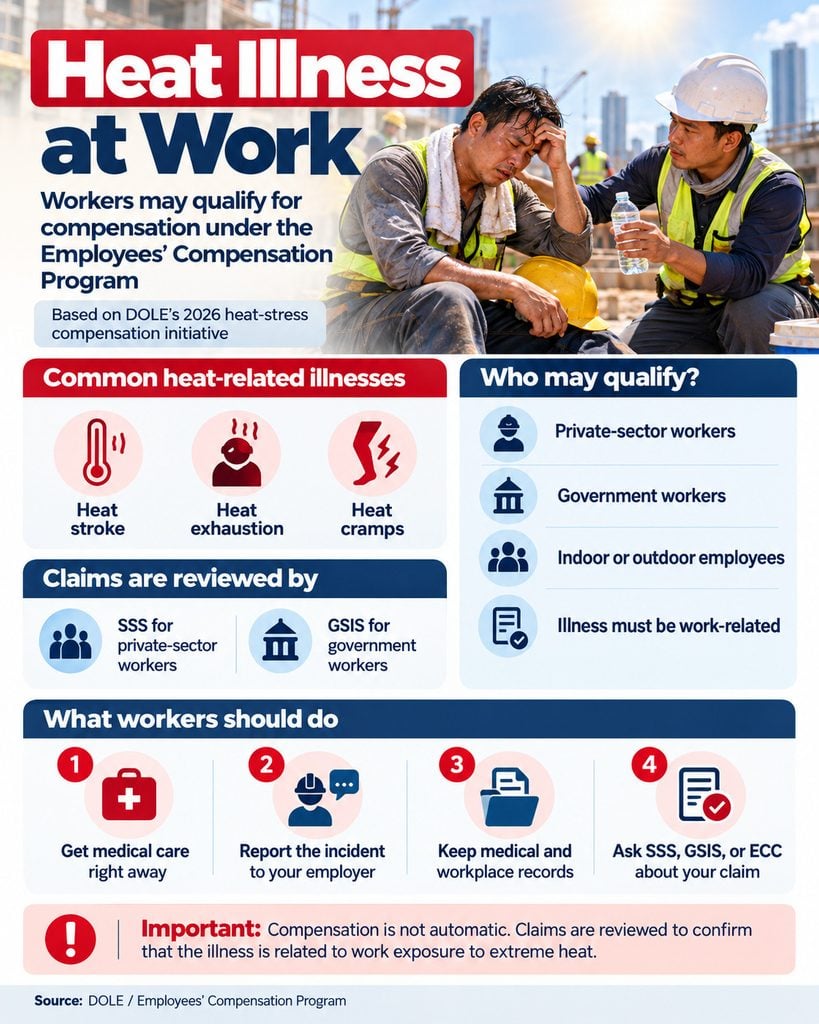
Workers who suffer from heat stroke, heat exhaustion, or heat cramps because of their jobs may qualify for compensation under the government’s Employees’ Compensation Program (ECP).
The Department of Labor and Employment (DOLE) is preparing Labor Advisory No. 19, Series of 2026, to clarify compensation for heat-related illnesses during El Niño and other periods of extreme heat.
Labor Secretary Francis Tolentino announced the planned guidelines as the government works to improve workplace protection against dangerous temperatures.
Claims will still require proof that the illness is connected to the worker’s job.
Heat Stroke, Heat Exhaustion and Heat Cramps Covered
The proposed guidelines identify three common heat-related conditions:
- Heat stroke: A life-threatening condition in which the body becomes dangerously overheated.
- Heat exhaustion: An illness that may cause heavy sweating, weakness, dizziness and nausea.
- Heat cramps: Painful muscle spasms that can occur during physical activity in hot conditions.
Other illnesses may also qualify under existing compensation rules if workplace conditions significantly increased the risk of developing them.
A medical diagnosis alone does not automatically guarantee compensation.
Indoor and Outdoor Workers May Qualify
The planned guidelines cover eligible workers in both private and public employment.
This means compensation is not limited to construction workers, farmers, delivery riders or other employees working outdoors.
Indoor employees exposed to excessive heat may also qualify if their illness is proven to be work-related.
The ECP generally covers qualified SSS members in the private sector and GSIS members in government service.
For more information, read our guide to the Employees’ Compensation Commission and its benefits.
SSS and GSIS Will Review Compensation Claims
Workers who develop heat-related illnesses must establish a connection between their condition and workplace exposure.
Private-sector claims are processed through the Social Security System (SSS), while government employee claims are handled through the Government Service Insurance System (GSIS).
Supporting records may include medical findings, employment information, workplace incident reports and evidence of exposure to extreme heat.
Each application will be evaluated under applicable ECP requirements.
Workers can also read our guide to filing Employees’ Compensation claims through GSIS.
What Benefits Can Affected Workers Receive?
Depending on eligibility and the approved claim, the ECP may provide medical benefits, disability income support and rehabilitation services.
The amount and type of assistance depend on the worker’s condition and the applicable program rules.
These benefits are separate from regular SSS sickness benefits.
Learn more about the SSS sickness benefit program for workers unable to perform their jobs because of illness or injury.
What Workers Should Do After a Heat-Related Illness
Workers experiencing symptoms of serious heat illness should stop working, move to a cooler location and seek medical attention.
Heat stroke is a medical emergency requiring immediate treatment.
Affected employees should notify their employers and keep their medical records and workplace incident reports.
They may contact SSS, GSIS or the Employees’ Compensation Commission to ask about possible benefits and filing requirements.
DOLE’s final advisory should be checked for any additional procedures before submitting a claim under the new heat-stress guidance.