
Every year, many government employees wait for bonuses, allowances, and small rewards that help stretch their income. These benefits may look simple on paper, but tax rules decide whether you keep the full amount or lose part of it to withholding.
In 2025, the Bureau of Internal Revenue issued Bureau of Internal Revenue Revenue Regulations No. 004-2025. This issuance confirms that de minimis benefits remain tax exempt, but it also updates key ceilings and rules that directly affect government payroll.
The biggest updates are clear and practical.
The clothing or uniform allowance ceiling is now higher.
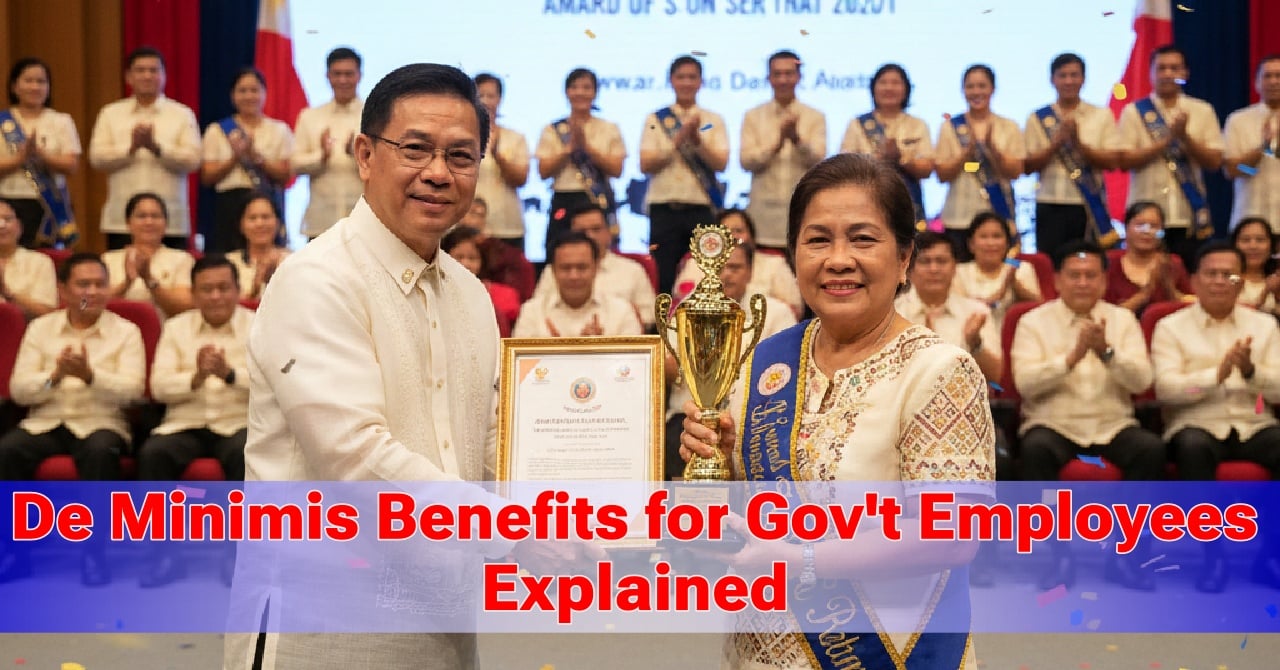
Employee achievement awards now allow cash and gift certificates within a set limit.
If you work in government or handle payroll, these changes matter right now.
What Are De Minimis Benefits
De minimis benefits are small value benefits given by employers to employees. When these benefits stay within set limits, they are not subject to income tax, not subject to withholding tax, and not subject to fringe benefit tax.
In simple terms, de minimis benefits are treated as help or support, not income.
Examples include:
- Uniform or clothing allowance
• Rice subsidy
• Laundry allowance
• Employee achievement awards
• Monetized vacation and sick leave for government employees
These benefits are listed and regulated under BIR issuances, not left to employer discretion.
De Minimis Benefits Under the TRAIN Law
Some employees worry that the TRAIN Law removed tax free benefits. That is not true.
The Tax Reform for Acceleration and Inclusion Act, or RA 10963, did not remove de minimis benefits. What it did was require the BIR to update rules, ceilings, and withholding guidelines through regulations and circulars.
Because of TRAIN, the BIR continues to refine:
- Which benefits qualify
• How much is tax free
• How excess amounts are taxed
RR No. 004-2025 is part of this ongoing update.
RR No. 004-2025 at a Glance
Revenue Regulations No. 004-2025 was issued on January 30, 2025.
It took effect 15 days after publication.
Its main purpose is to amend older rules under RR No. 2-98, especially on de minimis benefits.
Key Changes You Need to Know
- Uniform or clothing allowance increased to ₱7,000 per year
• Employee achievement awards allowed in cash or gift certificates
• Achievement awards capped at ₱10,000 per year
• Existing tax exempt treatment of de minimis benefits confirmed
These updates apply to both public and private employers, but some rules are especially relevant to government employees.
RR No. 4-2025Updated De Minimis Benefit Ceilings Explained
Clothing or Uniform Allowance
Before RR No. 004-2025, the ceiling was lower. Many agencies struggled to keep allowances tax free.
Under the new rule:
- Up to ₱7,000 per year is tax exempt
• Any amount beyond ₱7,000 becomes taxable
This helps agencies adjust to rising costs without triggering taxes for employees.
Employee Achievement Awards
This is one of the most important clarifications.
Achievement awards may now be given as:
- Cash
• Gift certificates
• Tangible items
The tax free ceiling is ₱10,000 per year.
However, there is a condition that must be met.
The award must be given under a written and established plan that:
- Applies fairly to employees
• Does not favor highly paid officials
• Clearly defines award criteria
Without proper documentation, the award may lose its de minimis status.
Special Rules for Government Employees
Monetized Vacation and Sick Leave
One key difference between public and private employees is the treatment of monetized leave.
For government employees:
- Monetized vacation leave
• Monetized sick leave
These are explicitly recognized as de minimis benefits under BIR rules.
This means monetized leave remains tax exempt, as long as it follows existing civil service and accounting rules.
This distinction is important because private sector leave monetization may be subject to different caps or treatment.
What Happens If a Benefit Exceeds the Ceiling?
De minimis benefits are only tax free up to the allowed limit.
If a benefit exceeds the ceiling:
- The excess becomes taxable income
• It may be subject to withholding tax
For managerial or non rank and file employees, the excess may be subject to fringe benefit tax, depending on classification under BIR rules.
This is why payroll monitoring matters.
How De Minimis Benefits Interact With the ₱90,000 Rule
The well known ₱90,000 exemption applies to:
- 13th month pay
• Other benefits not classified as de minimis
De minimis benefits are separate from this ₱90,000 cap.
However:
- If a benefit does not qualify as de minimis
• Or exceeds the de minimis ceiling
That excess may be counted toward the ₱90,000 limit or taxed separately.
This is where payroll reconciliation becomes critical at year end.
Practical Payroll and Compliance Steps
Here is what agencies and payroll units should do now.
Update Payroll Systems
- Adjust clothing allowance ceiling to ₱7,000
• Set achievement award ceiling to ₱10,000
• Apply effectivity date based on RR No. 004-2025
This prevents automatic over taxation.
Review Written Award Plans
For achievement awards:
- Keep a written plan on file
• Show clear criteria
• Prove non discrimination
This protects both the agency and employees during audits.
Flag Excess Amounts Early
- Monitor benefits close to ceilings
• Tag excess amounts as taxable
• Apply correct withholding or fringe benefit tax
Early tagging avoids year end corrections.
Recent and Upcoming Developments
The BIR has shown a pattern of adjusting ceilings over time. Advisory firms and tax professionals expect more refinements in 2025 and 2026, especially as inflation affects benefit values.
Government employees and agencies should continue monitoring BIR issuances, revenue memoranda, and circulars to stay compliant.
Frequently Asked Questions
- Are de minimis benefits still tax free in 2025 and beyond?
Yes. RR No. 004-2025 confirms they remain tax exempt as long as they stay within the allowed ceilings.
- Is the ₱7,000 clothing allowance automatic?
No. It is the maximum tax free amount. Agencies may give less depending on policy.
- Can achievement awards be given in cash?
Yes. Cash and gift certificates are now allowed up to ₱10,000, with proper documentation.
- Is monetized leave taxable?
For government employees, monetized vacation and sick leave are treated as de minimis and remain tax exempt.
- What if my benefit exceeds the limit?
Only the excess becomes taxable. The amount within the ceiling stays tax free.
How De Minimis Updates Directly Help Employees
These changes matter because they protect money that would otherwise be taxed away.
With the higher ₱7,000 clothing and uniform allowance, employees can now use the full amount for required work items without losing a portion to tax. That means fewer out of pocket expenses for uniforms, shoes, or office wear, especially in agencies where these are mandatory.
Clear rules on achievement awards also mean recognition finally feels like a reward. When cash or gift certificates stay within the allowed limit, employees receive the full value of the award instead of seeing deductions on their payslip. This makes performance incentives more motivating and more fair.
For monetized leave, the benefit is immediate and practical. Because it remains tax exempt, employees can rely on the full amount during important moments such as medical needs, tuition payments, or family emergencies. There is no surprise reduction when the payout arrives.
Video: De Minimis Benefits Explained
The video walks the viewer through how small workplace perks help employees feel supported while keeping compensation simple and manageable.
It follows the story of everyday workers receiving modest allowances, small gifts, and basic assistance that stay within set limits so these tokens remain tax‑free.
It shows how these modest perks create smoother days at work, from a bag of rice to a short medical check, each one offered without turning into added income.
It also explains how anything that goes beyond the allowed amounts shifts into taxable territory, changing how employers compute an employee’s pay.
By the end, the viewer sees how these small gestures shape a workplace where benefits stay light, fair, and easy to understand.
Final Thoughts
RR No. 004-2025 does not remove benefits. It clarifies and modernizes them.
For government employees, the message is simple.
De minimis benefits are still protected.
You just need to know the updated limits and rules.
For agencies, compliance now prevents problems later.
Understanding these changes helps ensure that benefits remain what they were meant to be. Real support, not added tax burden.