
Filipinos can apply for voter registration at their local COMELEC election office during an authorized registration period.
Applicants must meet the age and residency requirements, establish their identity, and complete the required application process.
COMELEC Chairperson George Garcia announced that nationwide registration will resume on November 10, 2026, and run until July 30, 2027, according to the Philippine News Agency.
The announced period will cover new registration, reactivation, transfers, and updates to personal information.
Also Read: How to Register and Vote Overseas for OFWs Abroad

Who Can Register to Vote?
COMELEC lists the following qualifications for national and local elections:
- Filipino citizenship.
- At least 18 years old on or before election day.
- Residence in the Philippines for at least one year before the election.
- Residence in the intended voting locality for at least six months before the election.
- No disqualification under the law.
Applicants who are still 17 should ask the election office whether their birthday falls within the qualifying period for the coming election.
The Commission on Elections manages voter registration and maintains voter records.
Where to Register
The regular registration venue is the Office of the Election Officer, or OEO, serving the applicant’s city or municipality.
COMELEC also publishes schedules for alternative registration activities.
Before visiting a mall, school, or outreach venue, check whether COMELEC has announced a current registration activity there.
Confirm its dates, hours, and accepted transactions.
Accepted IDs for Voter Registration
COMELEC’s published list includes:
- PhilSys National ID.
- Philippine passport.
- LTO driver’s license or student permit.
- SSS, GSIS, or UMID card.
- PRC license.
- Postal ID.
- Senior citizen or PWD ID.
- Student or library card signed by the school authority.
- NBI clearance.
- Other valid government-issued IDs accepted by COMELEC.
Bring the original document for inspection.
A cedula and PNP clearance are not accepted as identification documents for voter registration under COMELEC’s published requirements.
Applicants without an accepted ID should ask the election office about the identification-under-oath procedure.
How to Register to Vote
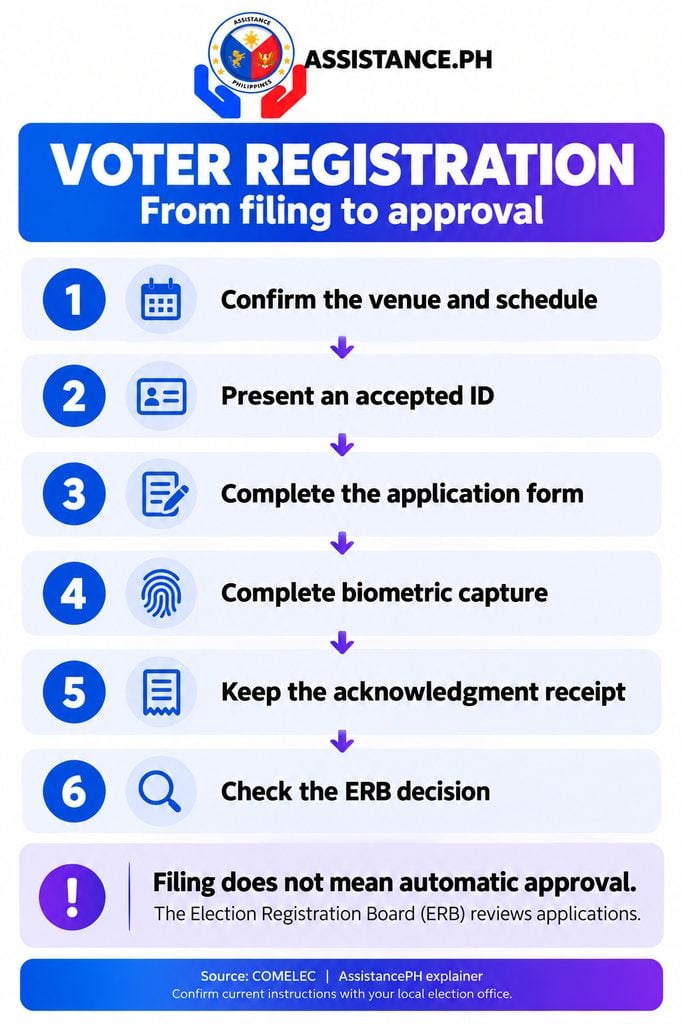
1. Confirm the Schedule and Venue
Contact the local election office before traveling.
Check whether it will accept the intended application on the chosen date.
2. Present an Accepted ID
Election staff will check the applicant’s identity, residence, and registration status.
Anyone with an existing voter record should tell the staff before completing a new registration form.
3. Complete the Application Form
Get the appropriate form from the election office or download it through COMELEC’s official website.
Application forms are available at the OEO free of charge.
Check all personal details before submitting the form.
For downloaded forms, leave the signature and thumbmark blank until appearing before the Election Officer.
4. Complete Biometric Capture
Authorized staff will capture the applicant’s biometric information using COMELEC’s registration equipment.
First-time applicants must appear personally for this step.
5. Keep the Acknowledgment Receipt
Keep the receipt issued after filing.
It can help when following up with the election office.
6. Check Whether the Application Was Approved
Filing an application does not automatically make someone a registered voter.
The Election Registration Board, or ERB, must approve or disapprove the application.
Ask the election office how to check the result.
Which Application Should Existing Voters File?
Existing voters should first check their records with the election office.
The correct transaction depends on what needs to change.
| Situation | Transaction to ask about |
|---|---|
| Moved to another voting locality | Transfer of registration |
| Voter record is inactive | Reactivation |
| Name or other information needs updating | Change or correction of entries |
| Unsure whether a voter record exists | Registration status verification |
COMELEC’s announced registration period includes transfers, reactivation, and personal information updates.
Supporting documents will depend on the transaction.
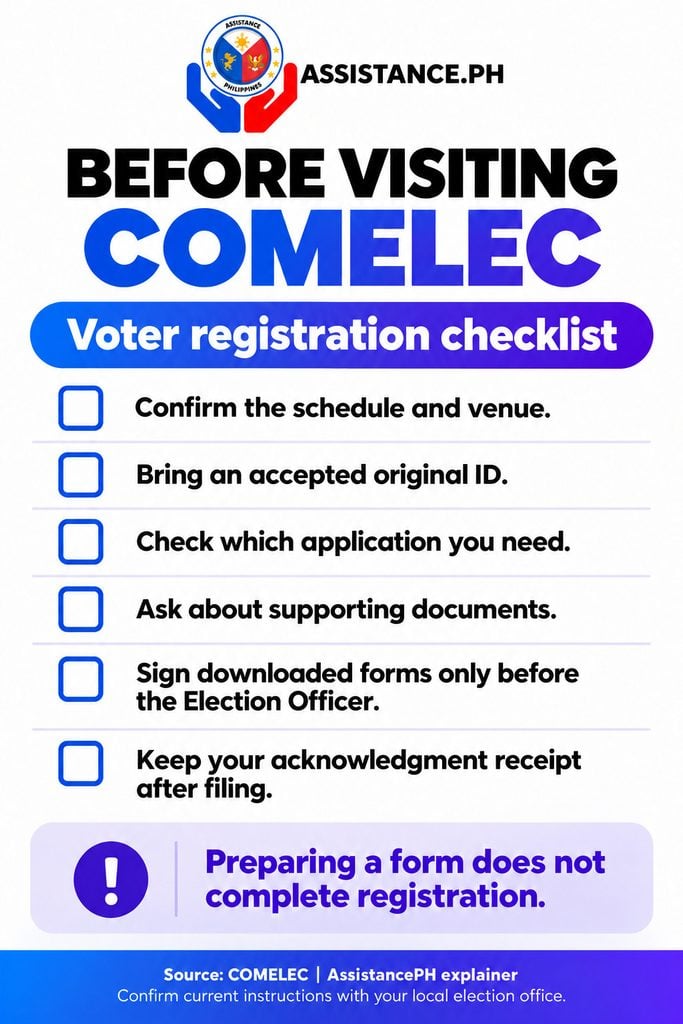
What to Ask Before Visiting COMELEC
Applicants who have registered before should explain their situation to the election office before filling out another form.
Useful details include their previous registered name, former address, and the city or municipality where they last registered.
They can ask these questions:
- Is the existing voter record active?
- Does moving to a new address require a transfer?
- Which documents support a name change or correction?
- What application is needed if the record is inactive?
- How can the applicant check the result after filing?
A person who cannot remember their precinct number should ask the election office how to locate their record.
Preparing these details can help staff identify the correct transaction.
Applicants should also mention any previous overseas voter registration so the office can advise on the appropriate process.
Before leaving, they should check the acknowledgment receipt and ask when and how to follow up on their application.
Can Registration Be Completed Online?
Completing an online form does not automatically approve voter registration.
COMELEC’s iRehistro information explains that applicants must still follow the required filing process.
The ERB must also review the application.
Applicants should check the current local registration instructions before using an online form.
The overseas iRehistro portal uses OVF1, which belongs to the separate overseas registration process.
That portal also states that biometric capture requires personal appearance.
What Applicants Should Do Next
Prepare an accepted ID and contact the local election office before the announced November 10 reopening.
Confirm the venue, schedule, and supporting documents for the intended application.
After filing, keep the acknowledgment receipt and check the application result.
Disclaimer: This content provides general information and is not an official COMELEC advisory.
Confirm current schedules, requirements, and procedures directly with COMELEC or the local Office of the Election Officer.