
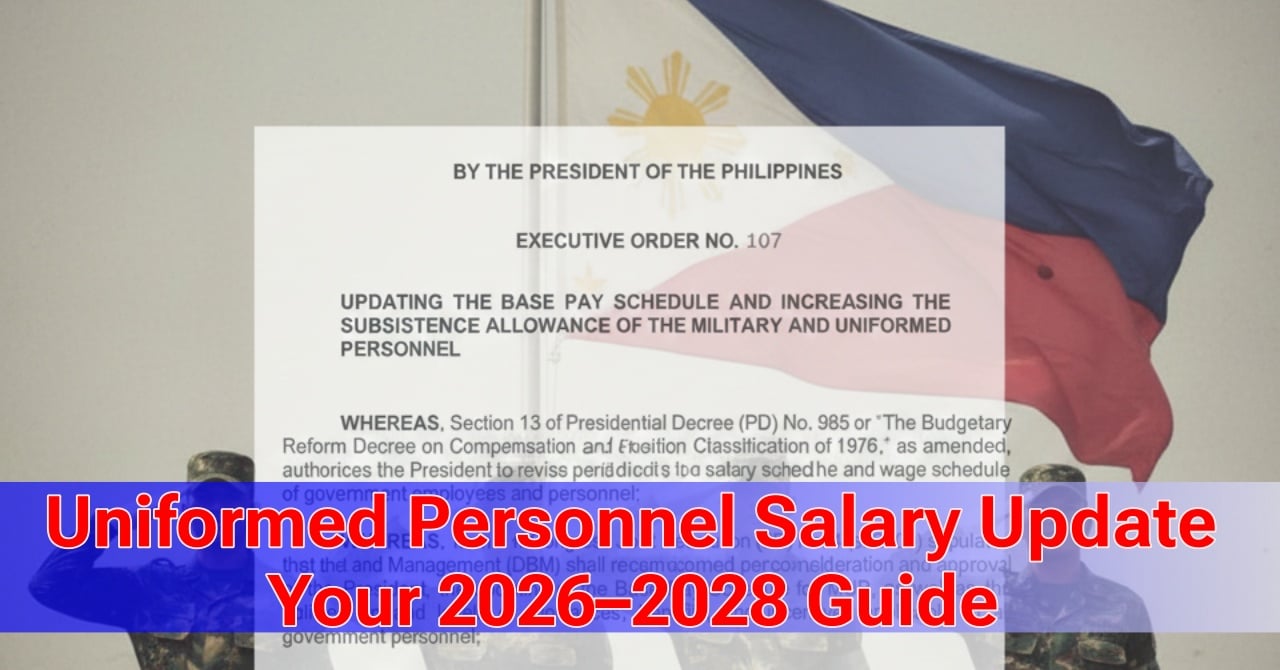
Money matters differently when your family relies on military or uniformed service pay. Every scheduled increase can affect how you budget, save, prepare for school expenses, or build your emergency fund. This is why the salary increase for military and uniformed personnel in the Philippines is important: it is not a one-time benefit, but a three-year rollout under Executive Order No. 107.
If you or a family member serves in the AFP, PNP, BJMP, BFP, PCG, BuCor, or NAMRIA, here is everything you need to know about the upcoming changes.
Who Is Covered Under the Salary Increase?
EO 107 sets the updated compensation structure for all Military and Uniformed Personnel (MUP), specifically:
- Military personnel under the Department of National Defense
- Uniformed personnel under the Department of the Interior and Local Government
- Philippine Coast Guard (PCG)
- Bureau of Corrections (BuCor)
- National Mapping and Resource Information Authority (NAMRIA)
Coverage is automatic if your rank or appointment status is classified under MUP categories in your agency.
What Is Changing Under EO 107?
Two major adjustments begin in 2026:
- Updated Base Pay Schedule
Your base pay will follow a revised schedule implemented in three tranches:
- January 1, 2026
- January 1, 2027
- January 1, 2028
Each tranche increases the base pay for all covered ranks and grades, following the official table in EO 107. Agencies will publish their own implementation circulars showing exact figures per rank.
- Standardized Subsistence Allowance
Beginning January 1, 2026, all eligible MUP will receive:
- ₱350 per day subsistence allowance
This standard rate applies across agencies unless later modified by separate directives.
20251203-EO-107-FRMSimplified Salary Tables for MUP Under EO 107
These tables summarize ONLY the Monthly Base Pay (MBP) for each tranche. Rank names vary across agencies (AFP, PNP, BJMP, BFP, PCG, BuCor, NAMRIA), but EO 107 provides a unified MBP value per equivalent rank.
To help you better understand the pay increase per tranche, each table below shows:
-
Rank Level
-
Sample Equivalent Positions
-
Monthly Base Pay (per tranche)
🟦 First Tranche Salary Schedule (Effective January 1, 2026)
| Rank Level | Examples of Equivalent Ranks (AFP/PNP/PCG/etc.) | MBP (₱) |
|---|---|---|
| Entry / Trainee | Candidate Soldier, Cadet | 19,516 – 40,284 |
| Private / Fire/Jail Officer I / Patrolman | Private, Apprentice Seaman, Patrolman/Patrolwoman | 31,151 – 31,774 |
| Corporal Level | Corporal, Fire/Jail Officer II, Police Corporal | 32,410 |
| Sergeant Level | Sergeant, Petty Officer III | 33,058 |
| Staff / Technical Sergeants | Fire/Jail Officer III, Petty Officer II | 33,720 – 34,394 |
| Master Sergeants | Master Sergeant, Chief Petty Officer | 35,082 – 35,783 |
| Senior Master / Chief Master Sergeants | Senior ranks across AFP/PNP/BuCor | 36,499 |
| Officer I (2LT / Ensign) | Probationary 2LT, Ensign | 40,284 – 46,020 |
| Officer II (1LT / LTJG) | Lieutenant Junior Grade, Inspector | 52,004 |
| Captain / LT | Captain, Lieutenant | 59,411 |
| Major | Major, Lieutenant Commander | 65,683 |
| Lieutenant Colonel | Lt Col, Superintendent | 74,879 |
| Colonel | Colonel / Senior Superintendent | 84,612 |
| Brigadier General | Brigadier General / Commodore | 95,611 |
| Major General & Up | Major General → General | 108,041 – 172,257 |
🟧 Second Tranche Salary Schedule (Effective January 1, 2027)
| Rank Level | Examples of Equivalent Ranks | MBP (₱) |
|---|---|---|
| Entry / Trainee | Candidate Soldier, Cadet | 20,445 – 42,202 |
| Private / Patrolman | Private, Apprentice Seaman, Patrolman/Patrolwoman | 32,634 – 33,286 |
| Corporal Level | Corporal, Fire/Jail Officer II, Police Corporal | 33,553 |
| Sergeant Level | Sergeant, Petty Officer III | 34,632 |
| Staff / Technical Sergeants | Fire/Jail Officer III, Police Staff Sergeant | 35,325 – 36,031 |
| Master Sergeants | Master Sergeant, Chief Petty Officer | 36,752 – 37,486 |
| Chief Master Sergeant | Senior/Chief Master ranks | 38,236 |
| Officer I (2LT / Ensign) | Probationary 2LT, Ensign | 42,202 – 48,211 |
| Officer II (1LT / LTJG) | Lieutenant Junior Grade, Inspector | 54,479 |
| Captain / LT | Captain, Lieutenant | 62,239 |
| Major | Major, Lieutenant Commander | 68,810 |
| Lieutenant Colonel | Lt Col, Superintendent | 78,443 |
| Colonel | Colonel / Senior Superintendent | 88,640 |
| Brigadier General | Brigadier General / Commodore | 100,162 |
| Major General & Up | Major General → General | 113,184 – 157,274 |
🟩 Third Tranche Salary Schedule (Effective January 1, 2028)
| Rank Level | Examples of Equivalent Ranks | MBP (₱) |
|---|---|---|
| Entry / Trainee | Candidate Soldier, Cadet | 21,375 – 44,122 |
| Private / Patrolman | Private, Apprentice Seaman, Patrolman/Patrolwoman | 34,119 – 34,801 |
| Corporal Level | Corporal, Fire/Jail Officer II, Police Corporal | 35,498 |
| Sergeant Level | Sergeant, Petty Officer III | 36,208 |
| Staff / Technical Sergeants | Staff Sergeant, Petty Officer II | 36,932 – 37,670 |
| Master Sergeants | Master Sergeant, Chief Petty Officer | 38,424 – 39,192 |
| Chief Master Sergeant | Senior/Chief Master ranks | 39,976 |
| Officer I (2LT / Ensign) | Probationary 2LT, Ensign | 44,122 – 50,405 |
| Officer II (1LT / LTJG) | Lieutenant Junior Grade, Inspector | 56,958 |
| Captain / LT | Captain, Lieutenant | 65,071 |
| Major | Major, Lieutenant Commander | 71,941 |
| Lieutenant Colonel | Lt Col, Superintendent | 82,012 |
| Colonel | Colonel / Senior Superintendent | 92,673 |
| Brigadier General | Brigadier General / Commodore | 104,719 |
| Major General & Up | Major General → General | 118,334 – 164,760 |
🟦 Subsistence Allowance Table
| Year | Subsistence Allowance Per Day |
|---|---|
| 2026 onward | ₱350/day |
Tranche Rollout and What Happens on Each Year
Why a three-year implementation?
This phased schedule helps the national budget absorb the adjustments while giving personnel predictable, forward-planning income changes.
Here is a simplified table based on the EO’s timeline:
| Tranche | Effective Date | Who Is Covered | What Changes | Notes |
| Tranche 1 | Jan 1, 2026 | DND, DILG uniformed, PCG, BuCor, NAMRIA | First adjustment to base pay; ₱350/day subsistence begins | Funded through FY 2026 budget |
| Tranche 2 | Jan 1, 2027 | Same | Second adjustment to base pay | Included in FY 2027 NEP proposal |
| Tranche 3 | Jan 1, 2028 | Same | Third adjustment to base pay | Included in FY 2028 NEP proposal |
If your agency has already released internal memos or HR/payroll notices, those documents contain the numbers specific to your rank.
How Will This Affect Your Payslip?
Expect two key changes starting 2026:
- Base Pay Line Adjustment
Your base pay will increase exactly on the tranche dates. If your payroll falls mid-month, the adjustment may appear in the first full pay cycle after January 1.
- Subsistence Allowance Update
Regardless of rank, the allowance line should show ₱350/day starting January 1, 2026.
What if your payslip shows a delay?
Agencies sometimes finalize adjustments after validation. In this case, you should see arrears credited once payroll catches up.
Budget and Implementation: Where Funding Comes From
EO 107 is structured so that funding aligns with national budgeting cycles:
- 2026 increases are funded through appropriations already included in the FY 2026 national budget.
- 2027 and 2028 increases form part of the proposals under the National Expenditure Program (NEP), which Congress reviews during yearly budget deliberations.
A Technical Working Group (TWG) will also review the MUP pension system
The EO creates a TWG composed of:
- Department of Budget and Management (DBM)
- Department of Finance (DOF)
- Bureau of the Treasury
- GSIS
Their goal is to study sustainability issues and propose reforms. While this does not directly change current pensions today, it may influence future rules.
What You Should Expect as a Beneficiary
Here is a practical breakdown of what the salary increase means for your day-to-day financial planning.
- You do not need to file anything
All adjustments are automatic through your agency payroll. No application or form is required.
- Keep your records updated
Outdated appointment papers, rank changes, or HR entries may delay your payroll update. Check that your:
- rank
- status
- promotion papers
- service records
are complete and updated.
- Promotions and transfers still follow the EO table
If you are promoted during a tranche year, HR will map your new rank to the salary level for that year.
- LWOP or special duty status may affect computation
If you are on Leave Without Pay during an effective month, your earnings reflect only the days you are eligible.
- Contractuals, trainees, and cadets
Coverage depends on whether your school, academy, or unit classifies your role as part of MUP. Confirm with your admin office.
How to Prepare for the Tranches
- Confirm your eligibility
Ask HR to verify your rank classification under EO 107. This avoids mistaken assumptions about coverage.
- Get your agency’s implementation circular
Each agency releases a table that translates EO numbers to their specific rank structure. Compare this with your current pay.
- Set reminders for each tranche date
Mark January 1, 2026 / 2027 / 2028. Check the first two pay periods after each date for correct rates.
- Track discrepancies early
If the amounts differ from the circular, file a written inquiry. Early reporting speeds up corrections.
- Watch for pension reform updates
The TWG review may influence how future pensions are calculated. Staying informed helps with long-term planning.
- Align your household budget
Since the increases are predictable, you can adjust savings, loan payments, or tuition plans with more certainty.
- Keep digital copies of memos
This makes it easier to file HR queries, support loan applications, or verify computations.
Special Situations to Know About
Promotions across tranche dates
Your rank as of the exact date determines your mapped salary. Later promotions follow the same year’s updated table.
Delayed payroll adjustments
Arrears will appear once your agency completes verification.
Special duty assignments
Subsistence allowance may have separate rules depending on duty conditions. Your HR office can explain exceptions.
Pensioners and retirees
Current pensions do not automatically increase when active-duty base pay rises. However, reforms may propose new links in the future.
Assistance Channels You Can Contact
For accurate, rank-specific guidance:
- Agency HR or Finance Service
Ask for the per-rank salary schedule and internal circular for EO 107 implementation.
- Official Gazette
Download Executive Order No. 107 and review the annexed tables.
- DBM and NEP budget documents
Review yearly NEP proposals to confirm funding for upcoming tranches.
Frequently Asked Questions
- Does the salary increase require an application?
No. It is automatically implemented through your agency payroll. - When will I see the increase?
Starting January 1, 2026, with additional increases in 2027 and 2028. - How much will my salary increase by?
Check your agency’s circular. EO 107 contains the full table, but agencies translate it per rank. - What is the subsistence allowance for 2026?
All eligible MUP receive ₱350/day. - Will pensioners get an increase too?
Not automatically. Pension reforms are still under review. - What if my payslip does not reflect the new rates?
Submit a written query to HR or payroll and attach your rank documentation. - Are contractuals or trainees included?
Only if classified as MUP under agency rules.
Watch: PBBM: Base pay, subsistence allowance ng military at uniformed personnel, itataas simula 2026
President Ferdinand Marcos Jr. announced that the base pay and subsistence allowance of military and uniformed personnel would rise starting January 2026.
He framed the move as part of the government’s effort to strengthen support for soldiers, police, and other uniformed services.
The announcement sparked mixed reactions, with some citizens urging that nurses and doctors in public hospitals also receive better compensation.
Others voiced concern that the adjustment favored one sector while leaving poor communities and other workers behind.
The decision marked a turning point in government priorities, highlighting both the promise of improved benefits and the debate over fairness in public service.
Final Thoughts
The salary increase under EO 107 may unfold over several years, but its impact begins the moment you understand how each tranche shapes your financial path. When your income is tied to service, clarity matters—and knowing what to expect helps you protect your family, plan ahead, and focus on your duty with fewer worries. Whether you’re active in the field, assigned to a unit, or supporting a loved one in uniform, these adjustments are meant to give more stability to the people who carry some of the country’s most demanding responsibilities. Staying informed is the first step to making every increase work for you and your household.