
Many Filipinos know the stress of lining up early, carrying a folder full of documents, only to hear the dreaded words: “Sir, ma’am, kulang po ito.”
A missing seal.
A blurred entry.
An outdated format.
These small issues cause big problems. For students, job seekers, OFWs, and families applying for aid or travel, document rejection means lost time, extra expenses, and emotional pressure. The fear is real, and it often stops people from pushing through with their applications.
The good news? Most verification failures are preventable. With the right checks and a bit of preparation, your documents can pass on the first try.
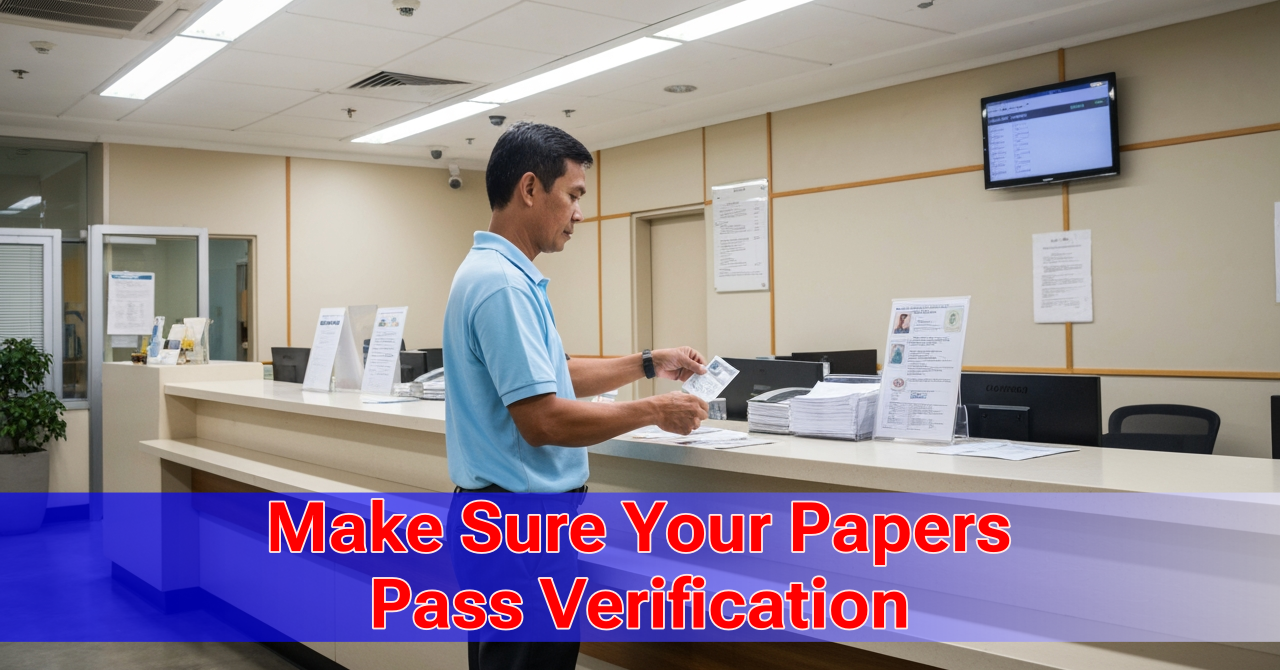
Why Many Filipinos Fear Document Rejection
Document rejection happens more often than people think. The root cause is simple: many applicants submit papers that look complete but do not meet technical verification rules.
Common reasons include:
- Missing or faded seals.
- PSA certificates with unclear entries.
- NBI clearances without dry seals.
- Old-school diplomas or TOR copies that are not “Certified True Copies.”
- Personal documents without notarized affidavits.
For OFWs and caregivers, even one rejected paper can delay a job contract or deployment. For families applying for social services, a single missing requirement can push back the entire process.
This is why document verification is a major mid-funnel barrier. People already understand the requirements—they just want to feel confident that their papers will pass.
Official Requirements You Must Follow
These rules are based on guidelines from DFA, DOH, PSA, DepEd, TESDA, CHED, and government agencies that handle identity, travel, and employment verification. Understanding these rules helps you avoid costly delays.
1. Always Bring the Original Copy
Photocopies or personal scans are not accepted as primary documents.
Agencies need the original for one reason: they check security features like watermarks, dry seals, signatures, and QR codes.
Examples:
- Original PSA birth certificates
- Original NBI Clearance
- Original TOR, diploma, and Form-137
- Original IDs (UMID, PhilID, driver’s license)
Bring photocopies too, but never rely on them alone.
2. Make Sure the Seal and Signature Are Visible
Verification officers reject documents when seals are missing, faded, or damaged.
For NBI Clearance:
- Must show the dry seal clearly.
- Must have a readable QR code.
For PSA Certificates (Birth, Marriage, CENOMAR):
- Must include the QR code that matches all entries.
- Any blurred print or missing detail can lead to rejection.
If the print quality is poor, request a reissued copy.
3. Use Only Certified True Copies for School Documents
Educational records must be certified by official institutions.
Accepted certifiers:
- Your issuing school
- DepEd (for basic education records)
- TESDA (for tech-voc records)
- CHED (for higher education records)
Look for these indicators:
- “Certified True Copy” stamp
- Signature of the registrar
- School seal or dry seal
- Updated format (older formats may be rejected)
4. Notarize Private Documents
Some papers are not issued by government agencies but are still used as supporting documents.
Examples:
- Certificates of employment
- Baptismal certificates
- Affidavits for name discrepancies
- Barangay certificates
These must be notarized to be legally valid. If an agency requires additional validation, attach supporting proof.
5. Medical Certificates Must Have DOH Recognition
Many agencies reject medical clearances if the issuing clinic is not DOH-accredited.
Look for:
- DOH stamp
- Clinic/doctor license number
- Complete diagnosis or assessment
- Valid date (many medical certs expire in 3–6 months)
6. Government IDs Require Both Original and Photocopy
Even if an ID is valid, agencies still ask for both. This allows them to verify authenticity without demanding another original.
Prepare at least:
- Original ID (UMID, PhilHealth, TIN ID, etc.)
- 1–2 photocopies
- Additional IDs if your primary ID is newly issued
7. Use Apostille for Documents Going Abroad
The Apostille certificate from DFA replaced the old red ribbon authentication.
Requirements vary by country, but in general:
- Bring the original document.
- Request Apostille processing from DFA.
- Use it for work, school, marriage, and immigration needs abroad.
An Apostilled document is recognized by most countries under the Apostille Convention.
Practical Techniques to Make Sure Your Documents Pass Verification
Now that you know the official rules, here’s how to prepare your documents in a way that avoids the most common pitfalls.
1. Match All Details Before Submission
Cross-check every name, date, place of birth, and spelling.
Examples:
- “Maria” vs “Ma.”
- “Santos” vs “Santos Jr.”
- Missing middle names
- Incorrect birth month or date
- Spelled-out vs numeric dates
If your PSA entry is wrong, request a Local Civil Registrar (LCR) copy to compare and validate before asking for a correction.
2. Check the Clarity of Your PSA Entries
A PSA document can still fail verification even if it’s authentic.
Reasons:
- Blurry text
- Faded seals
- Misaligned printing
- Low-quality QR code
If the document is unreadable, request a new copy or get the LCR entry for reference.
3. Update Your Records Early
For newly registered births, marriages, or corrections:
- The entry must appear in the PSA system before use.
- Processing usually takes weeks or months.
Submitting early avoids delays in job applications and travel requirements.
4. Compare Agency Requirements Before You Apply
Every agency follows its own rulebook.
Examples:
- PRC requires specific ID formats for board exam applications.
- LTO requires clear photocopies for license renewals.
- CAAP aviation applicants must present DOH-accredited medical evaluations.
Never assume that one agency’s standards apply to all.
5. Bring Backups
A simple backup can save you hours.
Prepare:
- 3–5 photocopies of each document
- Extra identification cards
- Extra 1×1 or 2×2 photos
- A digital copy in your email for quick printing
Even if not required, having backups avoids unnecessary delays.
How to Communicate With Confidence During Document Verification
If you’ve ever felt nervous while submitting your papers, you’re not alone. Many Filipinos worry that one small mistake might cause a delay—or worse, a rejection. But once you understand what verification officers really look for, you’ll feel more prepared and more confident every time you submit a document.
Use the steps below to guide your own preparation.
Real-Life Guidance You Can Apply Right Now
- Kung mag-aapply ka abroad, siguraduhin mo na malinaw ang QR code ng PSA certificate mo para hindi ma-hold.
Take a moment to scan it yourself. If the details match and the print is clear, you’re good to go. - Kung napapansin mong malabo ang birth certificate mo, humingi ka agad ng kopya mula sa Local Civil Registrar.
This gives you a clean backup that agencies often accept when PSA entries are unclear. - Kung luma ang format ng TOR mo o diploma mo, mag-request ka ng Certified True Copy mula sa registrar.
Updated, stamped, and sealed school records give you a much higher chance of passing verification on the first try.
When you follow these checks before submitting, you reduce the risk of delays and show officers that you’ve prepared thoroughly. Each small step gives you more control—and more confidence—as you complete your application.
Frequently Asked Questions
What documents get rejected most often?
PSA certificates with blurry entries, NBI clearances without dry seals, and school records without “Certified True Copy” stamps are the top reasons.
How do I know if my PSA certificate is valid?
Scan the QR code using any phone. The details must match your printed information exactly.
What should I do if my PSA document is unclear?
Go to your Local Civil Registrar and request a clearer copy or begin the correction process.
Do I need to notarize private documents?
Yes. Certificates of employment, affidavits, and baptismal records must be notarized to be considered valid supporting documents.
When do I need an Apostille?
If the document will be used abroad, you need DFA Apostille to prove it’s authentic.
Conclusion
Document verification does not have to be stressful. By understanding what agencies look for, preparing early, checking small details, and using the right versions of your documents, you can confidently face any application—local or abroad.
Think of verification as quality control. Once you know what to check, the process becomes simple and predictable.
When in doubt, always choose clarity, completeness, and correctness.