
The digital world has become part of everyday life for Filipinos — a space to connect, share stories, and express opinions. But for many, it’s also a place where bullying, harassment, and hate can spread rapidly. The Emman Atienza Bill seeks to change that by introducing stronger protections against cyberbullying, online hate, and digital harassment, while improving mental health support for victims.
Named in honor of Emman Atienza, a young woman whose tragic passing in 2025 was linked to online harassment, this bill—authored by Senator JV Ejercito in the Senate and Representative Albee Benitez in the House—calls for both accountability and compassion in addressing harmful behavior in digital spaces.
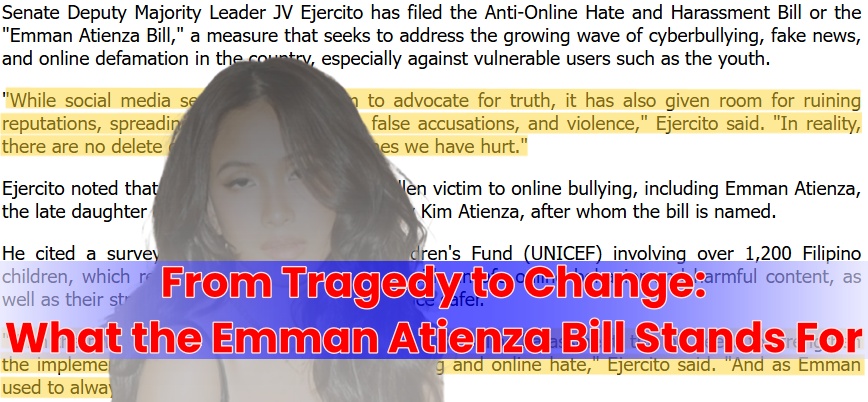
What the Emman Atienza Bill Is About
The bill, officially titled the Anti-Online Hate and Harassment Act, focuses on protecting Filipinos—especially the youth—from various forms of online abuse. It expands the scope of existing laws to reflect today’s digital realities.
Key goals include:
- Criminalizing cyberbullying and online hate speech – penalizing those who use digital platforms to harass, threaten, or humiliate others.
- Speeding up the removal of harmful content – by requiring clearer rules for takedown requests and cooperation with social-media companies.
- Protecting victims’ digital privacy – prohibiting doxxing (sharing personal data) and the non-consensual posting of private or sensitive material.
- Providing psychological and social support – connecting victims to counseling and rehabilitation services through the Department of Health (DOH) and the Department of Social Welfare and Development (DSWD).
- Promoting responsible digital citizenship – through education campaigns and school programs encouraging empathy and respect online.
Existing Laws It Builds Upon
The Philippines already has laws addressing cybercrime, bullying, and gender-based online violence, but enforcement remains inconsistent and often inaccessible to victims.
| Law | Focus | Why the Emman Atienza Bill Still Matters |
| Cybercrime Prevention Act of 2012 (RA 10175) | Penalizes cyberlibel, identity theft, and online abuse | Lacks focus on victim recovery and mental health |
| Anti-Bullying Act of 2013 (RA 10627) | Protects students from bullying, including online | Applies mainly to schools, not workplaces or public cyberbullying |
| Safe Spaces Act (RA 11313) | Addresses gender-based online harassment | Limited scope for other forms of hate and digital cruelty |
| Mental Health Act (RA 11036) | Recognizes mental health as a right | Implementation remains uneven; access to services is limited |
The Emman Atienza Bill complements these laws by bridging the gaps — introducing faster response mechanisms, stronger penalties, and built-in victim support systems.
Why the Bill Is Timely
The Philippines consistently ranks among the world’s heaviest social-media users. This connectivity, while empowering, has also magnified the risks of cyberbullying and online hate that can lead to anxiety, depression, and even suicide.
Senator Ejercito emphasized that legislation must go hand in hand with access to care. The bill’s call for mental-health referral systems and cross-agency coordination responds directly to the growing need for digital accountability and psychological support.
Potential Impact
If enacted and properly funded, the Emman Atienza Bill could:
- Deter online harassment through clearer penalties and accountability for offenders and platforms.
- Encourage victims to speak up by ensuring accessible reporting channels and counseling support.
- Promote safer digital environments where freedom of expression does not come at the cost of well-being.
- Connect justice and care, ensuring that those harmed online are not left to recover alone.
However, experts caution that its success will depend on adequate funding, training for law enforcement, and partnerships between government agencies and online platforms to make protection truly accessible.
Beyond Legislation
While the bill strengthens legal protections, the deeper change must come from society itself. Parents, educators, creators, and netizens all have a role in making online spaces kinder and more humane.
As Senator Ejercito said upon filing the bill:
“We need to bring back kindness online.”
Frequently Asked Questions (FAQs)
- Is the Emman Atienza Bill mainly about mental health?
Yes. It recognizes the serious mental and emotional toll of online harassment. The bill ensures that victims can access professional help through the DOH and DSWD alongside legal remedies. - How is this different from the Cybercrime Prevention Act?
While the Cybercrime Law defines offenses, the Emman Atienza Bill focuses on faster intervention and mental health support, not just punishment. - Does this replace the Mental Health Act?
No. The Mental Health Act mandates general access to care, while this bill activates those services specifically for victims of cyberbullying and online hate. - Who will implement it?
The DOJ, PNP Anti-Cybercrime Group, DSWD, and DOH will work together with schools, LGUs, and online platforms to enforce the law and provide immediate support. - Why is it named after Emman Atienza?
It honors Emman’s life and the advocacy her story sparked—to prevent future tragedies by making the digital world safer, more compassionate, and more accountable.
Watch: Emman Atienza Bill Sparks Push for Mental Health Protection
Emman Atienza’s passing moved the nation and prompted lawmakers to act.
The proposed Emman Atienza Bill aims to strengthen mental health awareness and address online bullying with sharper legal tools.
Her family’s emotional tributes revealed years of silent struggle, urging the public to speak up and seek help early.
Supporters believe the bill can help bridge gaps in psychiatric access and make mental health care more reachable for ordinary Filipinos.
As the conversation grows, many call for laws that respond to real pain—not just headlines.
In Conclusion
The Emman Atienza Bill is not about labor rights or employment reform. It is a mental-health-centered response to online harassment and hate. By criminalizing cyberbullying, protecting victims’ privacy, and linking them to psychological care, it honors Emman’s memory and the countless lives affected by digital cruelty.
This measure reminds us that the internet should be a place for connection, not harm—and that real compassion means building systems where help is always within reach.